# seed for reproducible demos; not exported so importing the module leaves the global RNG alone
from nimrod.utils import set_seed
from fastcore.test import test_eq
set_seed()Convolution Neural Networks
Conv filters
cfg = OmegaConf.load('../config/data/image/mnist.yaml')
dm = instantiate(cfg)
dm.prepare_data()
dm.setup()
[14:49:25] INFO - Init ImageDataModule for mnist
[14:49:29] INFO - loading dataset mnist with args () from split train
[14:49:29] INFO - loading dataset mnist from split train--------------------------------------------------------------------------- KeyboardInterrupt Traceback (most recent call last) Cell In[6], line 4 2 cfg = OmegaConf.load('../config/data/image/mnist.yaml') 3 dm = instantiate(cfg) ----> 4 dm.prepare_data() 5 dm.setup() File ~/Projects/nimrod/nimrod/image/datasets.py:415, in ImageDataModule.prepare_data(self) 412 """Download data if needed 413 """ 414 # train set --> 415 self.train_ds = ImageDataset( 416 self.hparams.name, 417 *self.args, 418 data_dir = self.hparams.data_dir, 419 split='train', 420 transforms = self.hparams.transforms, 421 **self.kwargs 422 ) 423 # get num classes before setup method converst ImageDataset to Subset 424 self._num_classes = self.train_ds.num_classes File ~/Projects/nimrod/nimrod/image/datasets.py:228, in ImageDataset.__init__(self, name, data_dir, split, transforms, streaming, exclude_grey_scale, verification_mode, from_image_folder, from_disk, *args) 226 else: 227 logger.info(f"loading dataset {name} from split {split}") --> 228 self.hf_ds = load_dataset( 229 name, 230 *args, 231 split=split, 232 cache_dir=data_dir, 233 download_mode='reuse_dataset_if_exists', 234 streaming=streaming, 235 verification_mode=verification_mode 236 237 ) 239 # CHANGE IMAGE COLUMN NAME IF NEEDED 240 self.image_column_name = 'image' File ~/miniconda3/envs/nimrod/lib/python3.11/site-packages/datasets/load.py:2129, in load_dataset(path, name, data_dir, data_files, split, cache_dir, features, download_config, download_mode, verification_mode, keep_in_memory, save_infos, revision, token, streaming, num_proc, storage_options, trust_remote_code, **config_kwargs) 2124 verification_mode = VerificationMode( 2125 (verification_mode or VerificationMode.BASIC_CHECKS) if not save_infos else VerificationMode.ALL_CHECKS 2126 ) 2128 # Create a dataset builder -> 2129 builder_instance = load_dataset_builder( 2130 path=path, 2131 name=name, 2132 data_dir=data_dir, 2133 data_files=data_files, 2134 cache_dir=cache_dir, 2135 features=features, 2136 download_config=download_config, 2137 download_mode=download_mode, 2138 revision=revision, 2139 token=token, 2140 storage_options=storage_options, 2141 trust_remote_code=trust_remote_code, 2142 _require_default_config_name=name is None, 2143 **config_kwargs, 2144 ) 2146 # Return iterable dataset in case of streaming 2147 if streaming: File ~/miniconda3/envs/nimrod/lib/python3.11/site-packages/datasets/load.py:1886, in load_dataset_builder(path, name, data_dir, data_files, cache_dir, features, download_config, download_mode, revision, token, storage_options, trust_remote_code, _require_default_config_name, **config_kwargs) 1884 builder_cls = get_dataset_builder_class(dataset_module, dataset_name=dataset_name) 1885 # Instantiate the dataset builder -> 1886 builder_instance: DatasetBuilder = builder_cls( 1887 cache_dir=cache_dir, 1888 dataset_name=dataset_name, 1889 config_name=config_name, 1890 data_dir=data_dir, 1891 data_files=data_files, 1892 hash=dataset_module.hash, 1893 info=info, 1894 features=features, 1895 token=token, 1896 storage_options=storage_options, 1897 **builder_kwargs, 1898 **config_kwargs, 1899 ) 1900 builder_instance._use_legacy_cache_dir_if_possible(dataset_module) 1902 return builder_instance File ~/miniconda3/envs/nimrod/lib/python3.11/site-packages/datasets/builder.py:342, in DatasetBuilder.__init__(self, cache_dir, dataset_name, config_name, hash, base_path, info, features, token, repo_id, data_files, data_dir, storage_options, writer_batch_size, **config_kwargs) 340 config_kwargs["data_dir"] = data_dir 341 self.config_kwargs = config_kwargs --> 342 self.config, self.config_id = self._create_builder_config( 343 config_name=config_name, 344 custom_features=features, 345 **config_kwargs, 346 ) 348 # prepare info: DatasetInfo are a standardized dataclass across all datasets 349 # Prefill datasetinfo 350 if info is None: 351 # TODO FOR PACKAGED MODULES IT IMPORTS DATA FROM src/packaged_modules which doesn't make sense File ~/miniconda3/envs/nimrod/lib/python3.11/site-packages/datasets/builder.py:597, in DatasetBuilder._create_builder_config(self, config_name, custom_features, **config_kwargs) 594 raise ValueError(f"BuilderConfig must have a name, got {builder_config.name}") 596 # resolve data files if needed --> 597 builder_config._resolve_data_files( 598 base_path=self.base_path, 599 download_config=DownloadConfig(token=self.token, storage_options=self.storage_options), 600 ) 602 # compute the config id that is going to be used for caching 603 config_id = builder_config.create_config_id( 604 config_kwargs, 605 custom_features=custom_features, 606 ) File ~/miniconda3/envs/nimrod/lib/python3.11/site-packages/datasets/builder.py:206, in BuilderConfig._resolve_data_files(self, base_path, download_config) 204 if isinstance(self.data_files, DataFilesPatternsDict): 205 base_path = xjoin(base_path, self.data_dir) if self.data_dir else base_path --> 206 self.data_files = self.data_files.resolve(base_path, download_config) File ~/miniconda3/envs/nimrod/lib/python3.11/site-packages/datasets/data_files.py:818, in DataFilesPatternsDict.resolve(self, base_path, download_config) 816 out = DataFilesDict() 817 for key, data_files_patterns_list in self.items(): --> 818 out[key] = data_files_patterns_list.resolve(base_path, download_config) 819 return out File ~/miniconda3/envs/nimrod/lib/python3.11/site-packages/datasets/data_files.py:771, in DataFilesPatternsList.resolve(self, base_path, download_config) 768 for pattern, allowed_extensions in zip(self, self.allowed_extensions): 769 try: 770 data_files.extend( --> 771 resolve_pattern( 772 pattern, 773 base_path=base_path, 774 allowed_extensions=allowed_extensions, 775 download_config=download_config, 776 ) 777 ) 778 except FileNotFoundError: 779 if not has_magic(pattern): File ~/miniconda3/envs/nimrod/lib/python3.11/site-packages/datasets/data_files.py:388, in resolve_pattern(pattern, base_path, allowed_extensions, download_config) 383 if protocol == "hf" and config.HF_HUB_VERSION >= version.parse("0.20.0"): 384 # 10 times faster glob with detail=True (ignores costly info like lastCommit) 385 glob_kwargs["expand_info"] = False 386 matched_paths = [ 387 filepath if filepath.startswith(protocol_prefix) else protocol_prefix + filepath --> 388 for filepath, info in fs.glob(pattern, detail=True, **glob_kwargs).items() 389 if info["type"] == "file" 390 and (xbasename(filepath) not in files_to_ignore) 391 and not _is_inside_unrequested_special_dir(filepath, fs_pattern) 392 and not _is_unrequested_hidden_file_or_is_inside_unrequested_hidden_dir(filepath, fs_pattern) 393 ] # ignore .ipynb and __pycache__, but keep /../ 394 if allowed_extensions is not None: 395 out = [ 396 filepath 397 for filepath in matched_paths 398 if any("." + suffix in allowed_extensions for suffix in xbasename(filepath).split(".")[1:]) 399 ] File ~/miniconda3/envs/nimrod/lib/python3.11/site-packages/huggingface_hub/hf_file_system.py:521, in HfFileSystem.glob(self, path, **kwargs) 519 kwargs = {"expand_info": kwargs.get("detail", False), **kwargs} 520 path = self.resolve_path(path, revision=kwargs.get("revision")).unresolve() --> 521 return super().glob(path, **kwargs) File ~/miniconda3/envs/nimrod/lib/python3.11/site-packages/fsspec/spec.py:611, in AbstractFileSystem.glob(self, path, maxdepth, **kwargs) 608 else: 609 depth = None --> 611 allpaths = self.find(root, maxdepth=depth, withdirs=True, detail=True, **kwargs) 613 pattern = glob_translate(path + ("/" if ends_with_sep else "")) 614 pattern = re.compile(pattern) File ~/miniconda3/envs/nimrod/lib/python3.11/site-packages/huggingface_hub/hf_file_system.py:556, in HfFileSystem.find(self, path, maxdepth, withdirs, detail, refresh, revision, **kwargs) 533 """ 534 List all files below path. 535 (...) 553 `Union[List[str], Dict[str, Dict[str, Any]]]`: List of paths or dict of file information. 554 """ 555 if maxdepth: --> 556 return super().find( 557 path, maxdepth=maxdepth, withdirs=withdirs, detail=detail, refresh=refresh, revision=revision, **kwargs 558 ) 559 resolved_path = self.resolve_path(path, revision=revision) 560 path = resolved_path.unresolve() File ~/miniconda3/envs/nimrod/lib/python3.11/site-packages/fsspec/spec.py:502, in AbstractFileSystem.find(self, path, maxdepth, withdirs, detail, **kwargs) 499 # Add the root directory if withdirs is requested 500 # This is needed for posix glob compliance 501 if withdirs and path != "" and self.isdir(path): --> 502 out[path] = self.info(path) 504 for _, dirs, files in self.walk(path, maxdepth, detail=True, **kwargs): 505 if withdirs: File ~/miniconda3/envs/nimrod/lib/python3.11/site-packages/huggingface_hub/hf_file_system.py:719, in HfFileSystem.info(self, path, refresh, revision, **kwargs) 717 out = out1[0] 718 if refresh or out is None or (expand_info and out and out["last_commit"] is None): --> 719 paths_info = self._api.get_paths_info( 720 resolved_path.repo_id, 721 resolved_path.path_in_repo, 722 expand=expand_info, 723 revision=resolved_path.revision, 724 repo_type=resolved_path.repo_type, 725 ) 726 if not paths_info: 727 _raise_file_not_found(path, None) File ~/miniconda3/envs/nimrod/lib/python3.11/site-packages/huggingface_hub/utils/_validators.py:114, in validate_hf_hub_args.<locals>._inner_fn(*args, **kwargs) 111 if check_use_auth_token: 112 kwargs = smoothly_deprecate_use_auth_token(fn_name=fn.__name__, has_token=has_token, kwargs=kwargs) --> 114 return fn(*args, **kwargs) File ~/miniconda3/envs/nimrod/lib/python3.11/site-packages/huggingface_hub/hf_api.py:3295, in HfApi.get_paths_info(self, repo_id, paths, expand, revision, repo_type, token) 3292 revision = quote(revision, safe="") if revision is not None else constants.DEFAULT_REVISION 3293 headers = self._build_hf_headers(token=token) -> 3295 response = get_session().post( 3296 f"{self.endpoint}/api/{repo_type}s/{repo_id}/paths-info/{revision}", 3297 data={ 3298 "paths": paths if isinstance(paths, list) else [paths], 3299 "expand": expand, 3300 }, 3301 headers=headers, 3302 ) 3303 hf_raise_for_status(response) 3304 paths_info = response.json() File ~/miniconda3/envs/nimrod/lib/python3.11/site-packages/requests/sessions.py:637, in Session.post(self, url, data, json, **kwargs) 626 def post(self, url, data=None, json=None, **kwargs): 627 r"""Sends a POST request. Returns :class:`Response` object. 628 629 :param url: URL for the new :class:`Request` object. (...) 634 :rtype: requests.Response 635 """ --> 637 return self.request("POST", url, data=data, json=json, **kwargs) File ~/miniconda3/envs/nimrod/lib/python3.11/site-packages/requests/sessions.py:589, in Session.request(self, method, url, params, data, headers, cookies, files, auth, timeout, allow_redirects, proxies, hooks, stream, verify, cert, json) 584 send_kwargs = { 585 "timeout": timeout, 586 "allow_redirects": allow_redirects, 587 } 588 send_kwargs.update(settings) --> 589 resp = self.send(prep, **send_kwargs) 591 return resp File ~/miniconda3/envs/nimrod/lib/python3.11/site-packages/requests/sessions.py:724, in Session.send(self, request, **kwargs) 721 if allow_redirects: 722 # Redirect resolving generator. 723 gen = self.resolve_redirects(r, request, **kwargs) --> 724 history = [resp for resp in gen] 725 else: 726 history = [] File ~/miniconda3/envs/nimrod/lib/python3.11/site-packages/requests/sessions.py:724, in <listcomp>(.0) 721 if allow_redirects: 722 # Redirect resolving generator. 723 gen = self.resolve_redirects(r, request, **kwargs) --> 724 history = [resp for resp in gen] 725 else: 726 history = [] File ~/miniconda3/envs/nimrod/lib/python3.11/site-packages/requests/sessions.py:265, in SessionRedirectMixin.resolve_redirects(self, resp, req, stream, timeout, verify, cert, proxies, yield_requests, **adapter_kwargs) 263 yield req 264 else: --> 265 resp = self.send( 266 req, 267 stream=stream, 268 timeout=timeout, 269 verify=verify, 270 cert=cert, 271 proxies=proxies, 272 allow_redirects=False, 273 **adapter_kwargs, 274 ) 276 extract_cookies_to_jar(self.cookies, prepared_request, resp.raw) 278 # extract redirect url, if any, for the next loop File ~/miniconda3/envs/nimrod/lib/python3.11/site-packages/requests/sessions.py:703, in Session.send(self, request, **kwargs) 700 start = preferred_clock() 702 # Send the request --> 703 r = adapter.send(request, **kwargs) 705 # Total elapsed time of the request (approximately) 706 elapsed = preferred_clock() - start File ~/miniconda3/envs/nimrod/lib/python3.11/site-packages/huggingface_hub/utils/_http.py:93, in UniqueRequestIdAdapter.send(self, request, *args, **kwargs) 91 """Catch any RequestException to append request id to the error message for debugging.""" 92 try: ---> 93 return super().send(request, *args, **kwargs) 94 except requests.RequestException as e: 95 request_id = request.headers.get(X_AMZN_TRACE_ID) File ~/miniconda3/envs/nimrod/lib/python3.11/site-packages/requests/adapters.py:667, in HTTPAdapter.send(self, request, stream, timeout, verify, cert, proxies) 664 timeout = TimeoutSauce(connect=timeout, read=timeout) 666 try: --> 667 resp = conn.urlopen( 668 method=request.method, 669 url=url, 670 body=request.body, 671 headers=request.headers, 672 redirect=False, 673 assert_same_host=False, 674 preload_content=False, 675 decode_content=False, 676 retries=self.max_retries, 677 timeout=timeout, 678 chunked=chunked, 679 ) 681 except (ProtocolError, OSError) as err: 682 raise ConnectionError(err, request=request) File ~/miniconda3/envs/nimrod/lib/python3.11/site-packages/urllib3/connectionpool.py:787, in HTTPConnectionPool.urlopen(self, method, url, body, headers, retries, redirect, assert_same_host, timeout, pool_timeout, release_conn, chunked, body_pos, preload_content, decode_content, **response_kw) 784 response_conn = conn if not release_conn else None 786 # Make the request on the HTTPConnection object --> 787 response = self._make_request( 788 conn, 789 method, 790 url, 791 timeout=timeout_obj, 792 body=body, 793 headers=headers, 794 chunked=chunked, 795 retries=retries, 796 response_conn=response_conn, 797 preload_content=preload_content, 798 decode_content=decode_content, 799 **response_kw, 800 ) 802 # Everything went great! 803 clean_exit = True File ~/miniconda3/envs/nimrod/lib/python3.11/site-packages/urllib3/connectionpool.py:534, in HTTPConnectionPool._make_request(self, conn, method, url, body, headers, retries, timeout, chunked, response_conn, preload_content, decode_content, enforce_content_length) 532 # Receive the response from the server 533 try: --> 534 response = conn.getresponse() 535 except (BaseSSLError, OSError) as e: 536 self._raise_timeout(err=e, url=url, timeout_value=read_timeout) File ~/miniconda3/envs/nimrod/lib/python3.11/site-packages/urllib3/connection.py:516, in HTTPConnection.getresponse(self) 513 _shutdown = getattr(self.sock, "shutdown", None) 515 # Get the response from http.client.HTTPConnection --> 516 httplib_response = super().getresponse() 518 try: 519 assert_header_parsing(httplib_response.msg) File ~/miniconda3/envs/nimrod/lib/python3.11/http/client.py:1390, in HTTPConnection.getresponse(self) 1388 try: 1389 try: -> 1390 response.begin() 1391 except ConnectionError: 1392 self.close() File ~/miniconda3/envs/nimrod/lib/python3.11/http/client.py:325, in HTTPResponse.begin(self) 323 # read until we get a non-100 response 324 while True: --> 325 version, status, reason = self._read_status() 326 if status != CONTINUE: 327 break File ~/miniconda3/envs/nimrod/lib/python3.11/http/client.py:286, in HTTPResponse._read_status(self) 285 def _read_status(self): --> 286 line = str(self.fp.readline(_MAXLINE + 1), "iso-8859-1") 287 if len(line) > _MAXLINE: 288 raise LineTooLong("status line") File ~/miniconda3/envs/nimrod/lib/python3.11/socket.py:706, in SocketIO.readinto(self, b) 704 while True: 705 try: --> 706 return self._sock.recv_into(b) 707 except timeout: 708 self._timeout_occurred = True File ~/miniconda3/envs/nimrod/lib/python3.11/ssl.py:1314, in SSLSocket.recv_into(self, buffer, nbytes, flags) 1310 if flags != 0: 1311 raise ValueError( 1312 "non-zero flags not allowed in calls to recv_into() on %s" % 1313 self.__class__) -> 1314 return self.read(nbytes, buffer) 1315 else: 1316 return super().recv_into(buffer, nbytes, flags) File ~/miniconda3/envs/nimrod/lib/python3.11/ssl.py:1166, in SSLSocket.read(self, len, buffer) 1164 try: 1165 if buffer is not None: -> 1166 return self._sslobj.read(len, buffer) 1167 else: 1168 return self._sslobj.read(len) KeyboardInterrupt:
x, y = dm.train_ds[0]
print(x.shape)
plt.figure(figsize=(3,3))
plt.imshow(x.squeeze(), cmap='gray')
torch.Size([1, 28, 28])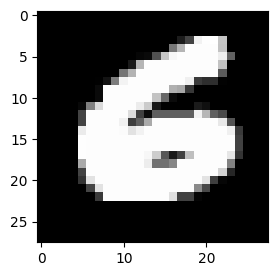
top_kernel = torch.tensor( # torch.tensor infers datatype vs. torch.Tensor
    [[-1., -1., -1.],
     [0., 0., 0.],
     [1., 1., 1.]]
)

bottom_kernel = torch.tensor( # torch.tensor infers datatype vs. torch.Tensor
    [[1., 1., 1.],
     [0., 0., 0.],
     [-1., -1., -1.]]
)

left_kernel = torch.tensor( # torch.tensor infers datatype vs. torch.Tensor
    [[-1., 0., 1.],
     [-1., 0., 1.],
     [-1., 0., 1.]]
)
my_kernel = left_kernel
c = nn.Conv2d(1, 1, kernel_size=3, padding=1, bias=False)
with torch.no_grad():
c.weight.copy_(my_kernel)
print(x.shape)
y = c(x)
print(y.shape)
plt.figure(figsize=(3,3))
plt.imshow(y.squeeze().detach(), cmap='gray')
plt.title('Convolution')
dc = nn.ConvTranspose2d(1, 1, kernel_size=3, padding=1, bias=False)
# with torch.no_grad():
# dc.weight.copy_(my_kernel)
x_bar = dc(y)
print(x_bar.shape)
plt.figure(figsize=(3,3))
plt.imshow(x_bar.squeeze().detach(), cmap='gray')
plt.title('Convolution transpose')--------------------------------------------------------------------------- NameError Traceback (most recent call last) Cell In[9], line 3 1 #| notest ----> 3 my_kernel = left_kernel 5 c = nn.Conv2d(1, 1, kernel_size=3, padding=1, bias=False) 6 with torch.no_grad(): NameError: name 'left_kernel' is not defined
Conv Block
Using a convolution with a stride of 2 instead of max pooling essentially achieves the same goal of downsampling an image by reducing its spatial dimensions, but with the key difference that the convolution layer can learn more complex feature combinations from overlapping regions, while max pooling only selects the maximum value within a window, potentially losing information about the finer details within that region; making the convolution with stride approach often preferred for preserving more spatial information in a neural network.
ConvBlock
 ConvBlock (in_channels:int=3, out_channels:int=16, kernel_size:int=3,
            stride:int=2, bias:bool=True, normalization:Optional[Type[torc
            h.nn.modules.module.Module]]=<class
            'torch.nn.modules.batchnorm.BatchNorm2d'>, activation:Optional
            [Type[torch.nn.modules.module.Module]]=<class
            'torch.nn.modules.activation.ReLU'>)
Base class for all neural network modules.
Your models should also subclass this class.
Modules can also contain other Modules, allowing them to be nested in a tree structure. You can assign the submodules as regular attributes::
import torch.nn as nn
import torch.nn.functional as F

class Model(nn.Module):
    def __init__(self) -> None:
        super().__init__()
        self.conv1 = nn.Conv2d(1, 20, 5)
        self.conv2 = nn.Conv2d(20, 20, 5)

    def forward(self, x):
        x = F.relu(self.conv1(x))
        return F.relu(self.conv2(x))
Submodules assigned in this way will be registered, and will also have their parameters converted when you call :meth:to, etc.
.. note:: As per the example above, an __init__() call to the parent class must be made before assignment on the child.
| Type | Default | Details | |
|---|---|---|---|
| in_channels | int | 3 | input channels |
| out_channels | int | 16 | output channels |
| kernel_size | int | 3 | kernel size |
| stride | int | 2 | stride |
| bias | bool | True | bias is False if BatchNorm |
| normalization | Optional | BatchNorm2d | normalization |
| activation | Optional | ReLU | activation |
Usage
B, C, H, W = 64, 1, 28, 28
X = torch.rand(B, C, H,W)
# stride 2 layer downsample to (W/2, H/2)
model = ConvBlock(
    in_channels=C,
    out_channels=16,
    kernel_size=3,
    stride=2,
    bias=True,
    normalization=nn.BatchNorm2d,
    )

# get first layer of sequential and init weights
layer_0 = model.net[0] # get first layer of sequential
with torch.no_grad():
    model.net[0].weight.copy_(top_kernel)

print("Y: ", model(X).shape)
# # flatten all dims except batch dim 1
Y = torch.flatten(model(X), 1)
print(Y.shape)
summary(model, input_size=(B, C, H, W), depth=2)
[13:58:07] WARNING - setting conv bias back to False as Batchnorm is usedY: torch.Size([64, 16, 14, 14])
torch.Size([64, 3136])==========================================================================================
Layer (type:depth-idx) Output Shape Param #
==========================================================================================
ConvBlock [64, 16, 14, 14] --
├─Sequential: 1-1 [64, 16, 14, 14] --
│ └─Conv2d: 2-1 [64, 16, 14, 14] 144
│ └─BatchNorm2d: 2-2 [64, 16, 14, 14] 32
│ └─ReLU: 2-3 [64, 16, 14, 14] --
==========================================================================================
Total params: 176
Trainable params: 176
Non-trainable params: 0
Total mult-adds (Units.MEGABYTES): 1.81
==========================================================================================
Input size (MB): 0.20
Forward/backward pass size (MB): 3.21
Params size (MB): 0.00
Estimated Total Size (MB): 3.41
==========================================================================================nn.Sequential(
ConvBlock(1, 8),
ConvBlock(8, 16),
ConvBlock(16, 32),
ConvBlock(32, 16)
)(X).shape[13:58:09] WARNING - setting conv bias back to False as Batchnorm is used
[13:58:09] WARNING - setting conv bias back to False as Batchnorm is used
[13:58:09] WARNING - setting conv bias back to False as Batchnorm is used
[13:58:09] WARNING - setting conv bias back to False as Batchnorm is usedtorch.Size([64, 16, 2, 2])Configs
cfg = OmegaConf.load('../config/model/image/convblock.yaml')
net = instantiate(cfg.defaults)
B, C, H, W = 64, 1, 28, 28
X = torch.rand(B, C, H,W)
print(summary(net))
print("Y: ",net(X).shape)
Seed set to 42
[14:49:51] WARNING - setting conv bias back to False as Batchnorm is used=================================================================
Layer (type:depth-idx) Param #
=================================================================
ConvBlock --
├─Sequential: 1-1 --
│ └─Conv2d: 2-1 144
│ └─BatchNorm2d: 2-2 32
│ └─ReLU: 2-3 --
=================================================================
Total params: 176
Trainable params: 176
Non-trainable params: 0
=================================================================
Y: torch.Size([64, 16, 14, 14])Pre-Activation Conv Block
PreActivationConvBlock
 PreActivationConvBlock (in_channels:int=3, out_channels:int=16,
                         kernel_size:int=3, stride:int=2, bias:bool=True,
                         normalization:Optional[Type[torch.nn.modules.modu
                         le.Module]]=<class
                         'torch.nn.modules.batchnorm.BatchNorm2d'>, activa
                         tion:Optional[Type[torch.nn.modules.module.Module
                         ]]=<class 'torch.nn.modules.activation.ReLU'>)
Base class for all neural network modules.
Your models should also subclass this class.
Modules can also contain other Modules, allowing them to be nested in a tree structure. You can assign the submodules as regular attributes::
import torch.nn as nn
import torch.nn.functional as F

class Model(nn.Module):
    def __init__(self) -> None:
        super().__init__()
        self.conv1 = nn.Conv2d(1, 20, 5)
        self.conv2 = nn.Conv2d(20, 20, 5)

    def forward(self, x):
        x = F.relu(self.conv1(x))
        return F.relu(self.conv2(x))
Submodules assigned in this way will be registered, and will also have their parameters converted when you call :meth:to, etc.
.. note:: As per the example above, an __init__() call to the parent class must be made before assignment on the child.
| Type | Default | Details | |
|---|---|---|---|
| in_channels | int | 3 | input channels |
| out_channels | int | 16 | output channels |
| kernel_size | int | 3 | kernel size |
| stride | int | 2 | stride |
| bias | bool | True | |
| normalization | Optional | BatchNorm2d | |
| activation | Optional | ReLU |
B, C, H, W = 64, 1, 28, 28
X = torch.rand(B, C, H,W)
# stride 2 layer downsample to (W/2, H/2)
model = PreActivationConvBlock(
    in_channels=C,
    out_channels=16,
    kernel_size=3,
    stride=2,
    bias=True,
    normalization=nn.BatchNorm2d,
    )

# get last layer of sequential and init weights
layer_0 = model.net[0] # get first layer of sequential
with torch.no_grad():
    model.net[-1].weight.copy_(top_kernel)

print("Y: ", model(X).shape)
# # flatten all dims except batch dim 1
Y = torch.flatten(model(X), 1)
print(Y.shape)
summary(model, input_size=(B, C, H, W), depth=2)
[13:58:16] WARNING - setting conv bias back to False as Batchnorm is usedY: torch.Size([64, 16, 14, 14])
torch.Size([64, 3136])==========================================================================================
Layer (type:depth-idx) Output Shape Param #
==========================================================================================
PreActivationConvBlock [64, 16, 14, 14] --
├─Sequential: 1-1 [64, 16, 14, 14] --
│ └─BatchNorm2d: 2-1 [64, 1, 28, 28] 2
│ └─ReLU: 2-2 [64, 1, 28, 28] --
│ └─Conv2d: 2-3 [64, 16, 14, 14] 144
==========================================================================================
Total params: 146
Trainable params: 146
Non-trainable params: 0
Total mult-adds (Units.MEGABYTES): 1.81
==========================================================================================
Input size (MB): 0.20
Forward/backward pass size (MB): 2.01
Params size (MB): 0.00
Estimated Total Size (MB): 2.21
==========================================================================================Deconv Block
DeconvBlock
 DeconvBlock (in_channels:int=16, out_channels:int=3, kernel_size:int=3,
              bias:bool=True, normalization:Optional[Type[torch.nn.modules
              .module.Module]]=None, activation:Optional[Type[torch.nn.mod
              ules.module.Module]]=<class
              'torch.nn.modules.activation.ReLU'>, scale_factor:int=2,
              use_transposed_conv:bool=False)
Base class for all neural network modules.
Your models should also subclass this class.
Modules can also contain other Modules, allowing them to be nested in a tree structure. You can assign the submodules as regular attributes::
import torch.nn as nn
import torch.nn.functional as F

class Model(nn.Module):
    def __init__(self) -> None:
        super().__init__()
        self.conv1 = nn.Conv2d(1, 20, 5)
        self.conv2 = nn.Conv2d(20, 20, 5)

    def forward(self, x):
        x = F.relu(self.conv1(x))
        return F.relu(self.conv2(x))
Submodules assigned in this way will be registered, and will also have their parameters converted when you call :meth:to, etc.
.. note:: As per the example above, an __init__() call to the parent class must be made before assignment on the child.
| Type | Default | Details | |
|---|---|---|---|
| in_channels | int | 16 | input channels |
| out_channels | int | 3 | output channels |
| kernel_size | int | 3 | kernel size |
| bias | bool | True | |
| normalization | Optional | None | |
| activation | Optional | ReLU | |
| scale_factor | int | 2 | |
| use_transposed_conv | bool | False |
Usage
B, C, H, W = 64, 3, 28, 28
X = torch.rand(B, C, H, W)
deconv = DeconvBlock(3, 8, scale_factor=2, kernel_size=3, use_transposed_conv=True)
print(deconv)
print("Y: ",deconv(X).shape)
DeconvBlock(
(_net): Sequential(
(0): ConvTranspose2d(3, 8, kernel_size=(3, 3), stride=(2, 2), padding=(1, 1), output_padding=(1, 1))
(1): ReLU()
)
)
Y: torch.Size([64, 8, 56, 56])Conv-Deconv
# one image
x, y = dm.train_ds[0]
C, H, W = x.shape
# make fake batch dimension
x = x.unsqueeze(0)
print("x:", x.shape)
plt.figure(figsize=(3,3))
plt.imshow(x.squeeze(), cmap='gray')
plt.title("original image")

my_kernel = left_kernel

c = ConvBlock(1,3, kernel_size=3, stride=1)
with torch.no_grad():
    c.net[0].weight.copy_(my_kernel) # set kernel weights for convlayer 0 (actual convolution2d)

y = c(x)
print("y: ", y.shape)

plt.figure(figsize=(3,3))
plt.imshow(y.detach().squeeze().numpy().transpose(1, 2, 0), cmap='gray')
plt.title("filtered image")


dc = DeconvBlock(3, 1, scale_factor=2, kernel_size=3)
with torch.no_grad():
    dc._net[1].weight.copy_(my_kernel) # set kernel weights for convlayer 1 (actual convolution2d)
x_bar = dc(y)
print("x_bar: ", x_bar.shape)
plt.figure(figsize=(3,3))
plt.imshow(x_bar.detach().squeeze(), cmap='gray')
plt.title("Deconv image")
--------------------------------------------------------------------------- TypeError Traceback (most recent call last) Cell In[14], line 4 1 #| notest 2 3 # one image ----> 4 x, y = dm.train_ds[0] 5 C, H, W = x.shape 6 # make fake batch dimension TypeError: 'NoneType' object is not subscriptable
ConvNet
Simple convolution network for image recognition
ConvNet
 ConvNet (n_features:List[int]=[1, 8, 16, 32, 64, 128],
          num_classes:int=10, kernel_size:int=3, bias:bool=False,
          normalization:torch.nn.modules.module.Module=<class
          'torch.nn.modules.batchnorm.BatchNorm2d'>,
          activation:torch.nn.modules.module.Module=<class
          'torch.nn.modules.activation.ReLU'>)
Base class for all neural network modules.
Your models should also subclass this class.
Modules can also contain other Modules, allowing them to be nested in a tree structure. You can assign the submodules as regular attributes::
import torch.nn as nn
import torch.nn.functional as F

class Model(nn.Module):
    def __init__(self) -> None:
        super().__init__()
        self.conv1 = nn.Conv2d(1, 20, 5)
        self.conv2 = nn.Conv2d(20, 20, 5)

    def forward(self, x):
        x = F.relu(self.conv1(x))
        return F.relu(self.conv2(x))
Submodules assigned in this way will be registered, and will also have their parameters converted when you call :meth:to, etc.
.. note:: As per the example above, an __init__() call to the parent class must be made before assignment on the child.
| Type | Default | Details | |
|---|---|---|---|
| n_features | List | [1, 8, 16, 32, 64, 128] | channel/feature expansion |
| num_classes | int | 10 | num_classes |
| kernel_size | int | 3 | kernel size |
| bias | bool | False | conv2d bias |
| normalization | Module | BatchNorm2d | normalization (before activation) |
| activation | Module | ReLU | activation function |
Usage
# data
B, C, H, W = 64, 3, 64, 64
X = torch.rand(B, C, H, W)
X.shape

n_features = [3, 8, 16, 32, 64, 128] #28 14 7 4 2 1
n_features = [3, 8, 16, 32, 64, 128, 64] #64, 32, 16, 8, 4, 2, 1
num_classes = 20

convnet = ConvNet(
    n_features=n_features, # channel/feature expansion
    num_classes=num_classes, # num_classes
    kernel_size=3, # kernel size
    bias=False, # conv2d bias
    normalization=nn.BatchNorm2d, # normalization (before activation)
    activation=nn.ReLU,
)
out = convnet(X)
print(out.shape)
print(summary(convnet, input_size=(X.shape), depth=2))
torch.Size([64, 20])
==========================================================================================
Layer (type:depth-idx) Output Shape Param #
==========================================================================================
ConvNet [64, 20] --
├─Sequential: 1-1 [64, 20] --
│ └─ConvBlock: 2-1 [64, 8, 64, 64] 232
│ └─ConvBlock: 2-2 [64, 16, 32, 32] 1,184
│ └─ConvBlock: 2-3 [64, 32, 16, 16] 4,672
│ └─ConvBlock: 2-4 [64, 64, 8, 8] 18,560
│ └─ConvBlock: 2-5 [64, 128, 4, 4] 73,984
│ └─ConvBlock: 2-6 [64, 64, 2, 2] 73,856
│ └─ConvBlock: 2-7 [64, 20, 1, 1] 11,560
│ └─Flatten: 2-8 [64, 20] --
==========================================================================================
Total params: 184,048
Trainable params: 184,048
Non-trainable params: 0
Total mult-adds (Units.MEGABYTES): 378.27
==========================================================================================
Input size (MB): 3.15
Forward/backward pass size (MB): 65.29
Params size (MB): 0.74
Estimated Total Size (MB): 69.18
==========================================================================================# from config
cfg = OmegaConf.load('../config/model/image/convnet.yaml')
# print(cfg.defaults)
# convnet = instantiate(cfg.defaults)
print(cfg.batchnorm)
convnet = instantiate(cfg.baseline)
# print(convnet(X).shape){'_target_': 'nimrod.models.conv.ConvNet', 'n_features': [1, 8, 16, 32, 64, 128], 'num_classes': 10, 'kernel_size': 3, 'bias': False, 'normalization': {'_target_': 'hydra.utils.get_class', 'path': 'torch.nn.BatchNorm2d'}, 'activation': {'_target_': 'hydra.utils.get_class', 'path': 'torch.nn.ReLU'}}# head yields (B, num_classes) unconstrained logits for every ConvNet config, whatever its depth
torch.manual_seed(0) # (out < 0).any() is probabilistic on random weights
X = torch.rand(8, 1, 28, 28)
cfg = OmegaConf.load('../config/model/image/convnet.yaml')
nets = {k: cfg[k] for k in ('batchnorm', 'baseline', 'fashion_mnist')}
for f in ('convnetx.yaml', 'convnetx_adam.yaml'):
nets[f] = OmegaConf.load(f'../config/model/image/{f}').nnet
nets['4-layer'] = OmegaConf.merge(cfg.batchnorm, {'n_features': [1, 8, 16, 32]})
for name, c in nets.items():
out = instantiate(c, num_classes=10).eval()(X)
test_eq(out.shape, (8, 10))
assert (out < 0).any(), nameTraining
Dataloaders
# data module config
cfg = OmegaConf.load('../config/data/image/fashion_mnist.yaml')

BATCH_SIZE = 512
datamodule = instantiate(cfg, batch_size=BATCH_SIZE)
datamodule.prepare_data()
datamodule.setup()

# one data point
X,y = datamodule.test_ds[0]
print("X (C,H,W): ", X.shape, "y: ", y)

# a batch of data via dataloader
XX,YY = next(iter(datamodule.test_dataloader()))
print("XX (B,C,H,W): ", XX.shape, "YY: ", YY.shape)

print(len(datamodule.train_ds))
print(len(datamodule.train_ds) // BATCH_SIZE)
[16:28:58] INFO - Init ImageDataModule for fashion_mnist
[16:29:17] INFO - split train into train/val [0.8, 0.2]
[16:29:17] INFO - train: 48000 val: 12000, test: 10000X (C,H,W): torch.Size([1, 32, 32]) y: 9
XX (B,C,H,W): torch.Size([512, 1, 32, 32]) YY: torch.Size([512])
48000
93Model & hardware
device = get_device()
print(device)
cfg = OmegaConf.load('../config/model/image/convnet.yaml')
# print(cfg.defaults)
# convnet = instantiate(cfg.defaults)
print(cfg.baseline)
convnet = instantiate(cfg.baseline)
model = convnet.to(device)

summary(model, input_size=(B, C, H, W), depth=4)
[16:29:17] INFO - Using device: mpsmps
{'_target_': 'nimrod.models.conv.ConvNet', 'n_features': [1, 8, 16, 32, 64], 'num_classes': 10, 'kernel_size': 3, 'bias': True, 'normalization': None, 'activation': {'_target_': 'hydra.utils.get_class', 'path': 'torch.nn.ReLU'}}==========================================================================================
Layer (type:depth-idx) Output Shape Param #
==========================================================================================
ConvNet [64, 40] --
├─Sequential: 1-1 [64, 40] --
│ └─ConvLayer: 2-1 [64, 8, 28, 28] --
│ │ └─Sequential: 3-1 [64, 8, 28, 28] --
│ │ │ └─Conv2d: 4-1 [64, 8, 28, 28] 80
│ │ │ └─ReLU: 4-2 [64, 8, 28, 28] --
│ └─ConvLayer: 2-2 [64, 16, 14, 14] --
│ │ └─Sequential: 3-2 [64, 16, 14, 14] --
│ │ │ └─Conv2d: 4-3 [64, 16, 14, 14] 1,168
│ │ │ └─ReLU: 4-4 [64, 16, 14, 14] --
│ └─ConvLayer: 2-3 [64, 32, 7, 7] --
│ │ └─Sequential: 3-3 [64, 32, 7, 7] --
│ │ │ └─Conv2d: 4-5 [64, 32, 7, 7] 4,640
│ │ │ └─ReLU: 4-6 [64, 32, 7, 7] --
│ └─ConvLayer: 2-4 [64, 64, 4, 4] --
│ │ └─Sequential: 3-4 [64, 64, 4, 4] --
│ │ │ └─Conv2d: 4-7 [64, 64, 4, 4] 18,496
│ │ │ └─ReLU: 4-8 [64, 64, 4, 4] --
│ └─ConvLayer: 2-5 [64, 10, 2, 2] --
│ │ └─Sequential: 3-5 [64, 10, 2, 2] --
│ │ │ └─Conv2d: 4-9 [64, 10, 2, 2] 5,770
│ └─Flatten: 2-6 [64, 40] --
==========================================================================================
Total params: 30,154
Trainable params: 30,154
Non-trainable params: 0
Total mult-adds (Units.MEGABYTES): 53.63
==========================================================================================
Input size (MB): 0.20
Forward/backward pass size (MB): 6.16
Params size (MB): 0.12
Estimated Total Size (MB): 6.49
==========================================================================================LR finder
cfg = OmegaConf.load('../config/model/image/convnet.yaml')
model = instantiate(cfg.batchnorm)
print(summary(model, depth=4))


criterion = nn.CrossEntropyLoss()
optimizer = torch.optim.Adam(model.parameters(), lr=1e-4) #, weight_decay=1e-5)

# Initialize LR Finder
lr_finder = LRFinder(model, optimizer, criterion, device=device)

# Run LR range test
lr_finder.range_test(
    datamodule.train_dataloader(),
    start_lr=1e-5,      # Extremely small starting learning rate
    end_lr=10,          # Large ending learning rate
    num_iter=100,   # Number of iterations to test
    smooth_f=0.05,   # Smoothing factor for the loss
    diverge_th=5,
)

# Plot the learning rate vs loss
_, lr_found = lr_finder.plot(log_lr=True)
print('Suggested lr:', lr_found)

lr_finder.reset()
=================================================================
Layer (type:depth-idx) Param #
=================================================================
ConvNet --
├─Sequential: 1-1 --
│ └─ConvLayer: 2-1 --
│ │ └─Sequential: 3-1 --
│ │ │ └─Conv2d: 4-1 72
│ │ │ └─BatchNorm2d: 4-2 16
│ │ │ └─ReLU: 4-3 --
│ └─ConvLayer: 2-2 --
│ │ └─Sequential: 3-2 --
│ │ │ └─Conv2d: 4-4 1,152
│ │ │ └─BatchNorm2d: 4-5 32
│ │ │ └─ReLU: 4-6 --
│ └─ConvLayer: 2-3 --
│ │ └─Sequential: 3-3 --
│ │ │ └─Conv2d: 4-7 4,608
│ │ │ └─BatchNorm2d: 4-8 64
│ │ │ └─ReLU: 4-9 --
│ └─ConvLayer: 2-4 --
│ │ └─Sequential: 3-4 --
│ │ │ └─Conv2d: 4-10 18,432
│ │ │ └─BatchNorm2d: 4-11 128
│ │ │ └─ReLU: 4-12 --
│ └─ConvLayer: 2-5 --
│ │ └─Sequential: 3-5 --
│ │ │ └─Conv2d: 4-13 73,728
│ │ │ └─BatchNorm2d: 4-14 256
│ │ │ └─ReLU: 4-15 --
│ └─ConvLayer: 2-6 --
│ │ └─Sequential: 3-6 --
│ │ │ └─Conv2d: 4-16 11,530
│ └─Flatten: 2-7 --
=================================================================
Total params: 110,018
Trainable params: 110,018
Non-trainable params: 0
=================================================================Stopping early, the loss has diverged
Learning rate search finished. See the graph with {finder_name}.plot()
LR suggestion: steepest gradient
Suggested LR: 2.01E-03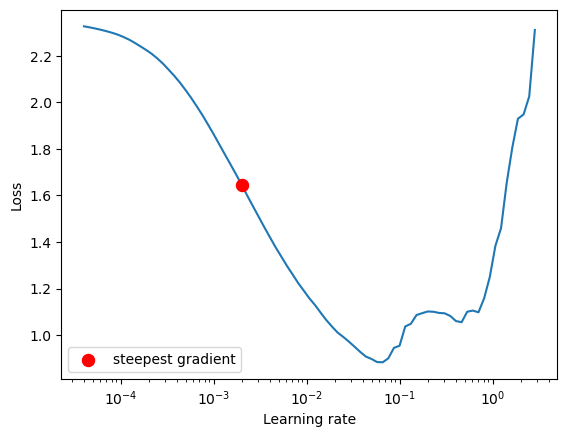
Suggested lr: 0.00200923300256504631-cycle warm-up
device = get_device()
# data module config
cfg_dm = OmegaConf.load('../config/data/image/fashion_mnist.yaml')
cfg_dm.batch_size = 512
datamodule = instantiate(cfg_dm)
datamodule.prepare_data()
datamodule.setup()

# device = 'cpu'
print(device)
cfg_mdl = OmegaConf.load('../config/model/image/convnet.yaml')
convnet = instantiate(cfg_mdl.batchnorm)
model = convnet.to(device)

N_EPOCHS = 5

lr_found = 3e-4

criterion = nn.CrossEntropyLoss()
optimizer = torch.optim.Adam(model.parameters(), lr=1e-4)
steps_per_epoch = len(datamodule.train_ds) // cfg_dm.batch_size
total_steps = steps_per_epoch* N_EPOCHS
print(f"size training set: {len(datamodule.train_ds)}, bs: {cfg_dm.batch_size}, steps/epoch: {steps_per_epoch}, total steps: {total_steps}")
# scheduler = torch.optim.lr_scheduler.OneCycleLR(optimizer, max_lr=0.01, steps_per_epoch=steps_per_epochs, epochs=1)

scheduler = torch.optim.lr_scheduler.OneCycleLR(
        optimizer,
        max_lr=lr_found,  # Peak learning rate
        # total_steps=len(datamodule.train_ds) * N_EPOCHS,  # Total training iterations
        steps_per_epoch=steps_per_epoch,
        epochs=N_EPOCHS,
        pct_start=0.3,  # 30% of training increasing LR, 70% decreasing
        anneal_strategy='cos',  # Cosine annealing
        div_factor=10,  # Initial lr = max_lr / div_factor
        # final_div_factor=1e4,
        three_phase=False  # Two phase LR schedule (increase then decrease)
    )

################################


lrs = []
current_step = 0
train_loss_history = []
eval_loss_history = []
avg_train_loss_hist = []
avg_eval_loss_hist = []
max_acc = 0

for epoch in range(N_EPOCHS):
    i = 0
    model.train()
    for images, labels in datamodule.train_dataloader():
        if current_step >= total_steps:
            print(f"Reached total steps: {current_step}/{total_steps}")
            break
        optimizer.zero_grad()
        images, labels = images.to(device), labels.to(device)
        outputs = model(images)
        loss = criterion(outputs, labels)
        loss.backward()
        optimizer.step()
        scheduler.step()
        current_step += 1
        train_loss_history.append(loss.item())
        # current_lr = scheduler.get_last_lr()[0]
        current_lr = optimizer.param_groups[0]['lr']
        lrs.append(current_lr)
        if not (i % 100):
            print(f"Loss {loss.item():.4f}, Current LR: {current_lr:.10f}, Step: {current_step}/{total_steps}")
        i += 1

    model.eval()
    with torch.no_grad():
        correct = 0
        total = 0
        for images, labels in datamodule.val_dataloader():
            # model expects input (B,H*W)
            images = images.to(device)
            labels = labels.to(device)
            # Pass the input through the model
            outputs = model(images)
            # eval loss
            eval_loss = criterion(outputs, labels)
            eval_loss_history.append(eval_loss.item())
            # Get the predicted labels
            _, predicted = torch.max(outputs.data, 1)

            # Update the total and correct counts
            total += labels.size(0)
            correct += (predicted == labels).sum()
            acc = 100 * correct / total
            if acc > max_acc:
                max_acc = acc

        # Print the accuracy
    print(f"Epoch {epoch + 1}: Last training Loss {loss.item():.4f}, Last Eval loss {eval_loss.item():.4f} Accuracy = {100 * correct / total:.2f}% Best Accuracy: {max_acc:.2f}")
    # print(f'Current LR: {optimizer.param_groups[0]["lr"]:.5f}')

###################
plt.figure(1)
plt.subplot(211)
plt.ylabel('loss')
plt.xlabel('step')
plt.plot(train_loss_history)
plt.plot(eval_loss_history)
plt.subplot(212)
plt.ylabel('lr')
plt.xlabel('step')
plt.plot(lrs)
Seed set to 42
Seed set to 42
[23:31:47] INFO - Init ImageDataModule for fashion_mnist
[23:31:52] INFO - loading dataset fashion_mnist with args () from split train
[23:32:00] INFO - loading dataset fashion_mnist with args () from split test
[23:32:03] INFO - split train into train/val [0.8, 0.2]
[23:32:03] INFO - train: 48000 val: 12000, test: 10000--------------------------------------------------------------------------- NameError Traceback (most recent call last) Cell In[9], line 11 8 datamodule.setup() 10 # device = 'cpu' ---> 11 print(device) 12 cfg_mdl = OmegaConf.load('../config/model/image/convnet.yaml') 13 convnet = instantiate(cfg_mdl.batchnorm) NameError: name 'device' is not defined
ConvNetX
ConvNetX
 ConvNetX (nnet:__main__.ConvNet, num_classes:int,
           optimizer:Callable[...,torch.optim.optimizer.Optimizer],
           scheduler:Optional[Callable[...,Any]]=None)
| Type | Default | Details | |
|---|---|---|---|
| nnet | ConvNet | model | |
| num_classes | int | number of classes | |
| optimizer | Callable | optimizer | |
| scheduler | Optional | None | scheduler |
Usage
cfg = OmegaConf.load('../config/model/image/convnetx.yaml')
feats_dim = [3, 8, 16, 32, 64, 128, 64]
cfg.nnet.n_features = feats_dim
cfg.nnet.num_classes = 200

model = instantiate(cfg.nnet)
B, C, H, W = 64, 3, 64, 64
X = torch.rand(B, C, H, W)
X.shape
print(model(X).shape)torch.Size([64, 200])summary(model, input_size=(B, C, H, W), depth=2)==========================================================================================
Layer (type:depth-idx) Output Shape Param #
==========================================================================================
ConvNet [64, 200] --
├─Sequential: 1-1 [64, 200] --
│ └─ConvBlock: 2-1 [64, 8, 64, 64] 232
│ └─ConvBlock: 2-2 [64, 16, 32, 32] 1,184
│ └─ConvBlock: 2-3 [64, 32, 16, 16] 4,672
│ └─ConvBlock: 2-4 [64, 64, 8, 8] 18,560
│ └─ConvBlock: 2-5 [64, 128, 4, 4] 73,984
│ └─ConvBlock: 2-6 [64, 64, 2, 2] 73,856
│ └─ConvBlock: 2-7 [64, 200, 1, 1] 115,600
│ └─Flatten: 2-8 [64, 200] --
==========================================================================================
Total params: 288,088
Trainable params: 288,088
Non-trainable params: 0
Total mult-adds (Units.MEGABYTES): 384.93
==========================================================================================
Input size (MB): 3.15
Forward/backward pass size (MB): 65.48
Params size (MB): 1.15
Estimated Total Size (MB): 69.78
==========================================================================================Nimrod training
N_EPOCHS = 5

# data module config
cfg = OmegaConf.load('../config/data/image/fashion_mnist.yaml')
cfg.batch_size = 512
cfg.num_workers = 0
datamodule = instantiate(cfg)
datamodule.prepare_data()
datamodule.setup()
[20:23:50] INFO - Init ImageDataModule for fashion_mnist
[20:24:08] INFO - split train into train/val [0.8, 0.2]
[20:24:08] INFO - train: 48000 val: 12000, test: 10000cfg = OmegaConf.load('../config/optimizer/adam_w.yaml')
optimizer = instantiate(cfg)
cfg = OmegaConf.load('../config/scheduler/step_lr.yaml')
scheduler = instantiate(cfg)
cfg = OmegaConf.load('../config/model/image/convnetx.yaml')
model = instantiate(cfg)(optimizer=optimizer, scheduler=scheduler)
# # with 1-cycle sched
# cfg.nnet.n_features = [1, 8, 16, 32, 64, 128]
# cfg.scheduler.total_steps = len(datamodule.train_ds) * N_EPOCHS
# model = instantiate(cfg)[14:53:05] INFO - ConvNetX: init
[14:53:05] INFO - Classifier: init
/user/s/slegroux/miniconda3/envs/nimrod/lib/python3.11/site-packages/lightning/pytorch/utilities/parsing.py:209: Attribute 'nnet' is an instance of `nn.Module` and is already saved during checkpointing. It is recommended to ignore them using `self.save_hyperparameters(ignore=['nnet'])`.trainer = Trainer(
accelerator="auto",
max_epochs=N_EPOCHS,
logger=TensorBoardLogger("tb_logs", name="fashion_mnist_convnet", default_hp_metric=True),
# logger=CSVLogger("logs", name="mnist_convnet"),
callbacks = [LearningRateMonitor(logging_interval="step")],
check_val_every_n_epoch=1,
log_every_n_steps=1
)GPU available: True (mps), used: True
TPU available: False, using: 0 TPU cores
HPU available: False, using: 0 HPUsLR finder
tuner = Tuner(trainer)
lr_finder = tuner.lr_find(
model,
datamodule=datamodule,
min_lr=1e-5,
max_lr=1.0,
num_training=100, # number of iterations
# attr_name="optimizer.lr",
)
fig = lr_finder.plot(suggest=True)
plt.show()
print(f"Suggested learning rate: {lr_finder.suggestion()}")[20:59:14] INFO - Optimizer: <class 'torch.optim.adamw.AdamW'>
[20:59:14] INFO - Scheduler: <torch.optim.lr_scheduler.StepLR object>
/Users/slegroux/miniforge3/envs/nimrod/lib/python3.11/site-packages/lightning/pytorch/trainer/connectors/data_connector.py:424: The 'train_dataloader' does not have many workers which may be a bottleneck. Consider increasing the value of the `num_workers` argument` to `num_workers=11` in the `DataLoader` to improve performance.
/Users/slegroux/miniforge3/envs/nimrod/lib/python3.11/site-packages/lightning/pytorch/trainer/connectors/data_connector.py:424: The 'val_dataloader' does not have many workers which may be a bottleneck. Consider increasing the value of the `num_workers` argument` to `num_workers=11` in the `DataLoader` to improve performance.`Trainer.fit` stopped: `max_steps=100` reached.
Learning rate set to 0.0019952623149688807
Restoring states from the checkpoint path at /Users/slegroux/Projects/nimrod/nbs/.lr_find_61a6646e-2298-4940-9b72-9185e67e8d21.ckpt
Restored all states from the checkpoint at /Users/slegroux/Projects/nimrod/nbs/.lr_find_61a6646e-2298-4940-9b72-9185e67e8d21.ckpt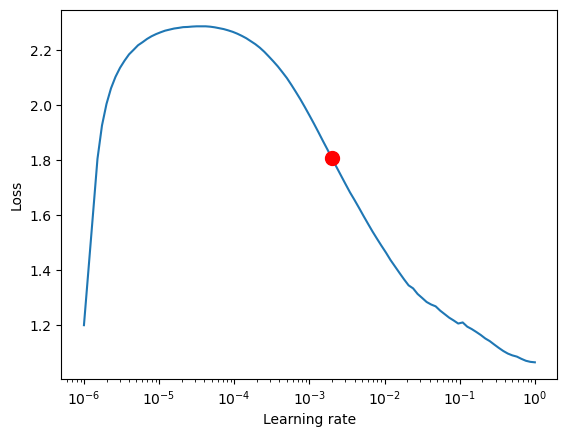
Suggested learning rate: 0.0019952623149688807print(trainer.max_epochs, len(datamodule.train_ds), datamodule.hparams.batch_size)
print(5*56000)
print(5*56000/2048)
print(5*56000//2048)10 48000 512
280000
136.71875
1361-cycle scheduling
N_EPOCHS = 1
# lr_found = lr_finder.suggestion()
lr_found = 3e-4
# DATA
cfg = OmegaConf.load('../config/data/image/mnist.yaml')
cfg.batch_size = 512
cfg.num_workers = 0
datamodule = instantiate(cfg)
datamodule.prepare_data()
datamodule.setup()
checkpoint_callback = ModelCheckpoint(
monitor='val/loss', # Metric to monitor
dirpath='checkpoints/', # Directory to save checkpoints
filename='epoch{epoch:02d}-val_loss{val/loss:.2f}',
auto_insert_metric_name=False,
save_top_k=1, # Save only the best checkpoint
mode='min' # Mode can be 'min' or 'max' depending on the metric
)
lr_monitor = LearningRateMonitor(logging_interval="step")
# TRAINER
trainer = Trainer(
accelerator="auto",
max_epochs=N_EPOCHS,
# logger=TensorBoardLogger("tb_logs", name="mnist_convnet", default_hp_metric=True),
logger=CSVLogger("logs", name="fashion_mnist_convnet"),
callbacks = [lr_monitor, checkpoint_callback],
check_val_every_n_epoch=1,
log_every_n_steps=1
)
print("estimated steps: ", trainer.estimated_stepping_batches, "accumulate_grad_batches: ", trainer.accumulate_grad_batches)
# MODEL
model_cfg = OmegaConf.load('../config/model/image/convnetx.yaml')
model_cfg.scheduler.total_steps = trainer.max_epochs * len(datamodule.train_dataloader())
model_cfg.scheduler.max_lr = lr_found#lr_finder.suggestion()
model = instantiate(model_cfg)
print("LR: ",model.lr)
trainer.fit(model, datamodule.train_dataloader(), datamodule.val_dataloader())
########################
csv_path = f"{trainer.logger.log_dir}/metrics.csv"
metrics = pd.read_csv(csv_path)
metrics.head()
##########################
plt.figure()
plt.plot(metrics['step'], metrics['train/loss_step'], 'b.-')
plt.plot(metrics['step'], metrics['val/loss'],'r.-')
plt.figure()
plt.plot(metrics['step'], metrics['lr-AdamW'], 'g.-')
plt.show()[23:33:22] INFO - Init ImageDataModule for mnist
[23:33:26] INFO - loading dataset mnist with args () from split train
[23:33:33] INFO - loading dataset mnist with args () from split test
[23:33:36] INFO - split train into train/val [0.8, 0.2]
[23:33:36] INFO - train: 48000 val: 12000, test: 10000
GPU available: True (mps), used: True
TPU available: False, using: 0 TPU cores
HPU available: False, using: 0 HPUs
Loading `train_dataloader` to estimate number of stepping batches.estimated steps: -1 accumulate_grad_batches: 1--------------------------------------------------------------------------- ConfigAttributeError Traceback (most recent call last) Cell In[10], line 41 39 # MODEL 40 model_cfg = OmegaConf.load('../config/model/image/convnetx.yaml') ---> 41 model_cfg.scheduler.total_steps = trainer.max_epochs * len(datamodule.train_dataloader()) 42 model_cfg.scheduler.max_lr = lr_found#lr_finder.suggestion() 44 model = instantiate(model_cfg) File ~/miniforge3/envs/nimrod/lib/python3.11/site-packages/omegaconf/dictconfig.py:355, in DictConfig.__getattr__(self, key) 351 return self._get_impl( 352 key=key, default_value=_DEFAULT_MARKER_, validate_key=False 353 ) 354 except ConfigKeyError as e: --> 355 self._format_and_raise( 356 key=key, value=None, cause=e, type_override=ConfigAttributeError 357 ) 358 except Exception as e: 359 self._format_and_raise(key=key, value=None, cause=e) File ~/miniforge3/envs/nimrod/lib/python3.11/site-packages/omegaconf/base.py:231, in Node._format_and_raise(self, key, value, cause, msg, type_override) 223 def _format_and_raise( 224 self, 225 key: Any, (...) 229 type_override: Any = None, 230 ) -> None: --> 231 format_and_raise( 232 node=self, 233 key=key, 234 value=value, 235 msg=str(cause) if msg is None else msg, 236 cause=cause, 237 type_override=type_override, 238 ) 239 assert False File ~/miniforge3/envs/nimrod/lib/python3.11/site-packages/omegaconf/_utils.py:899, in format_and_raise(node, key, value, msg, cause, type_override) 896 ex.ref_type = ref_type 897 ex.ref_type_str = ref_type_str --> 899 _raise(ex, cause) File ~/miniforge3/envs/nimrod/lib/python3.11/site-packages/omegaconf/_utils.py:797, in _raise(ex, cause) 795 else: 796 ex.__cause__ = None --> 797 raise ex.with_traceback(sys.exc_info()[2]) File ~/miniforge3/envs/nimrod/lib/python3.11/site-packages/omegaconf/dictconfig.py:351, in DictConfig.__getattr__(self, key) 348 raise AttributeError() 350 try: --> 351 return self._get_impl( 352 key=key, default_value=_DEFAULT_MARKER_, validate_key=False 353 ) 354 except ConfigKeyError as e: 355 self._format_and_raise( 356 key=key, value=None, cause=e, type_override=ConfigAttributeError 357 ) File ~/miniforge3/envs/nimrod/lib/python3.11/site-packages/omegaconf/dictconfig.py:442, in DictConfig._get_impl(self, key, default_value, validate_key) 438 def _get_impl( 439 self, key: DictKeyType, default_value: Any, validate_key: bool = True 440 ) -> Any: 441 try: --> 442 node = self._get_child( 443 key=key, throw_on_missing_key=True, validate_key=validate_key 444 ) 445 except (ConfigAttributeError, ConfigKeyError): 446 if default_value is not _DEFAULT_MARKER_: File ~/miniforge3/envs/nimrod/lib/python3.11/site-packages/omegaconf/basecontainer.py:73, in BaseContainer._get_child(self, key, validate_access, validate_key, throw_on_missing_value, throw_on_missing_key) 64 def _get_child( 65 self, 66 key: Any, (...) 70 throw_on_missing_key: bool = False, 71 ) -> Union[Optional[Node], List[Optional[Node]]]: 72 """Like _get_node, passing through to the nearest concrete Node.""" ---> 73 child = self._get_node( 74 key=key, 75 validate_access=validate_access, 76 validate_key=validate_key, 77 throw_on_missing_value=throw_on_missing_value, 78 throw_on_missing_key=throw_on_missing_key, 79 ) 80 if isinstance(child, UnionNode) and not _is_special(child): 81 value = child._value() File ~/miniforge3/envs/nimrod/lib/python3.11/site-packages/omegaconf/dictconfig.py:480, in DictConfig._get_node(self, key, validate_access, validate_key, throw_on_missing_value, throw_on_missing_key) 478 if value is None: 479 if throw_on_missing_key: --> 480 raise ConfigKeyError(f"Missing key {key!s}") 481 elif throw_on_missing_value and value._is_missing(): 482 raise MissingMandatoryValue("Missing mandatory value: $KEY") ConfigAttributeError: Missing key scheduler full_key: scheduler object_type=dict
trainer.test(model, datamodule.test_dataloader(), ckpt_path="best")Restoring states from the checkpoint path at /Users/slegroux/Projects/nimrod/nbs/checkpoints/epoch00-val_loss0.13.ckpt
Loaded model weights from the checkpoint at /Users/slegroux/Projects/nimrod/nbs/checkpoints/epoch00-val_loss0.13.ckpt
/Users/slegroux/miniforge3/envs/nimrod/lib/python3.11/site-packages/lightning/pytorch/trainer/connectors/data_connector.py:424: The 'test_dataloader' does not have many workers which may be a bottleneck. Consider increasing the value of the `num_workers` argument` to `num_workers=11` in the `DataLoader` to improve performance.┏━━━━━━━━━━━━━━━━━━━━━━━━━━━┳━━━━━━━━━━━━━━━━━━━━━━━━━━━┓ ┃ Test metric ┃ DataLoader 0 ┃ ┡━━━━━━━━━━━━━━━━━━━━━━━━━━━╇━━━━━━━━━━━━━━━━━━━━━━━━━━━┩ │ test/acc │ 0.9707000255584717 │ │ test/loss │ 0.11260439455509186 │ └───────────────────────────┴───────────────────────────┘
[{'test/loss': 0.11260439455509186, 'test/acc': 0.9707000255584717}]best_checkpoint_path = checkpoint_callback.best_model_path
print(f"Best checkpoint path: {best_checkpoint_path}")Best checkpoint path: /Users/slegroux/Projects/nimrod/nbs/checkpoints/epoch00-val_loss0.13.ckptResume training
cfg = OmegaConf.load('../config/scheduler/reduce_lr_on_plateau.yaml')
sched = instantiate(cfg)
# sched.total_steps = len(datamodule.train_ds) * N_EPOCHS
lr = trainer.optimizers[0].param_groups[0]['lr']
print(f"LR: {lr}")
# nnet is not in the hparams; hparams hold optimizer partials so torch>=2.6 needs weights_only=False
model = ConvNetX.load_from_checkpoint(best_checkpoint_path, nnet=model.nnet, scheduler=sched, lr=lr, weights_only=False)

pprint(model.hparams)
[20:56:41] INFO - ConvNetX: init
[20:56:41] INFO - Classifier: initLR: 7.642883799445691e-07
"nnet": ConvNet(
(net): Sequential(
(0): ConvLayer(
(net): Sequential(
(0): Conv2d(1, 8, kernel_size=(3, 3), stride=(1, 1), padding=(1, 1), bias=False)
(1): BatchNorm2d(8, eps=1e-05, momentum=0.1, affine=True, track_running_stats=True)
(2): ReLU()
)
)
(1): ConvLayer(
(net): Sequential(
(0): Conv2d(8, 16, kernel_size=(3, 3), stride=(2, 2), padding=(1, 1), bias=False)
(1): BatchNorm2d(16, eps=1e-05, momentum=0.1, affine=True, track_running_stats=True)
(2): ReLU()
)
)
(2): ConvLayer(
(net): Sequential(
(0): Conv2d(16, 32, kernel_size=(3, 3), stride=(2, 2), padding=(1, 1), bias=False)
(1): BatchNorm2d(32, eps=1e-05, momentum=0.1, affine=True, track_running_stats=True)
(2): ReLU()
)
)
(3): ConvLayer(
(net): Sequential(
(0): Conv2d(32, 64, kernel_size=(3, 3), stride=(2, 2), padding=(1, 1), bias=False)
(1): BatchNorm2d(64, eps=1e-05, momentum=0.1, affine=True, track_running_stats=True)
(2): ReLU()
)
)
(4): ConvLayer(
(net): Sequential(
(0): Conv2d(64, 128, kernel_size=(3, 3), stride=(2, 2), padding=(1, 1), bias=False)
(1): BatchNorm2d(128, eps=1e-05, momentum=0.1, affine=True, track_running_stats=True)
(2): ReLU()
)
)
(5): ConvLayer(
(net): Sequential(
(0): Conv2d(128, 10, kernel_size=(3, 3), stride=(2, 2), padding=(1, 1))
)
)
(6): Flatten(start_dim=1, end_dim=-1)
)
)
"num_classes": 10
"optimizer": functools.partial(<class 'torch.optim.adamw.AdamW'>, lr=0.0001, weight_decay=1e-05)
"scheduler": functools.partial(<class 'torch.optim.lr_scheduler.ReduceLROnPlateau'>, mode='min', factor=0.1, patience=10)/Users/slegroux/miniforge3/envs/nimrod/lib/python3.11/site-packages/lightning/pytorch/utilities/parsing.py:208: Attribute 'nnet' is an instance of `nn.Module` and is already saved during checkpointing. It is recommended to ignore them using `self.save_hyperparameters(ignore=['nnet'])`.# batchnorm should allow us to try higher LR
# model_cfg = OmegaConf.load('../config/model/image/convnetx_adam.yaml')
# model_cfg.optimizer.lr = 0.1
# model = instantiate(model_cfg)
# opt = instantiate(model_cfg.optimizer)
# print(opt)
# sched = instantiate(model_cfg.scheduler)
# print(sched)
N_EPOCHS = 3
trainer = Trainer(
accelerator="auto",
max_epochs=N_EPOCHS,
# logger=TensorBoardLogger("tb_logs", name="mnist_convnet", default_hp_metric=True),
logger=CSVLogger("logs", name="fashion_mnist_convnet"),
callbacks = [LearningRateMonitor(logging_interval="step")],
check_val_every_n_epoch=1,
log_every_n_steps=1
)
# use standar adam scheduler
# retrieve last ckpt
trainer.fit(model, datamodule.train_dataloader(), datamodule.val_dataloader(), ckpt_path=best_checkpoint_path)GPU available: True (mps), used: True
TPU available: False, using: 0 TPU cores
HPU available: False, using: 0 HPUs
Restoring states from the checkpoint path at /Users/slegroux/Projects/nimrod/nbs/checkpoints/epoch00-val_loss0.13.ckpt
/Users/slegroux/miniforge3/envs/nimrod/lib/python3.11/site-packages/lightning/pytorch/trainer/call.py:273: Be aware that when using `ckpt_path`, callbacks used to create the checkpoint need to be provided during `Trainer` instantiation. Please add the following callbacks: ["ModelCheckpoint{'monitor': 'val/loss', 'mode': 'min', 'every_n_train_steps': 0, 'every_n_epochs': 1, 'train_time_interval': None}"].
[20:56:49] INFO - Optimizer: AdamW (
Parameter Group 0
amsgrad: False
betas: (0.9, 0.999)
capturable: False
differentiable: False
eps: 1e-08
foreach: None
fused: None
lr: 0.0001
maximize: False
weight_decay: 1e-05
)
[20:56:49] INFO - Scheduler: <torch.optim.lr_scheduler.ReduceLROnPlateau object>
/Users/slegroux/miniforge3/envs/nimrod/lib/python3.11/site-packages/lightning/pytorch/core/optimizer.py:316: The lr scheduler dict contains the key(s) ['monitor'], but the keys will be ignored. You need to call `lr_scheduler.step()` manually in manual optimization.
| Name | Type | Params | Mode
------------------------------------------------------------
0 | loss | CrossEntropyLoss | 0 | train
1 | train_acc | MulticlassAccuracy | 0 | train
2 | val_acc | MulticlassAccuracy | 0 | train
3 | test_acc | MulticlassAccuracy | 0 | train
4 | train_loss | MeanMetric | 0 | train
5 | val_loss | MeanMetric | 0 | train
6 | test_loss | MeanMetric | 0 | train
7 | val_acc_best | MaxMetric | 0 | train
8 | nnet | ConvNet | 110 K | train
------------------------------------------------------------
110 K Trainable params
0 Non-trainable params
110 K Total params
0.440 Total estimated model params size (MB)
39 Modules in train mode
0 Modules in eval mode
Restored all states from the checkpoint at /Users/slegroux/Projects/nimrod/nbs/checkpoints/epoch00-val_loss0.13.ckpt/Users/slegroux/miniforge3/envs/nimrod/lib/python3.11/site-packages/lightning/pytorch/trainer/connectors/data_connector.py:424: The 'val_dataloader' does not have many workers which may be a bottleneck. Consider increasing the value of the `num_workers` argument` to `num_workers=11` in the `DataLoader` to improve performance.
/Users/slegroux/miniforge3/envs/nimrod/lib/python3.11/site-packages/lightning/pytorch/trainer/connectors/data_connector.py:424: The 'train_dataloader' does not have many workers which may be a bottleneck. Consider increasing the value of the `num_workers` argument` to `num_workers=11` in the `DataLoader` to improve performance.[20:57:08] INFO - scheduler is an instance of Reduce plateau[20:57:26] INFO - scheduler is an instance of Reduce plateau
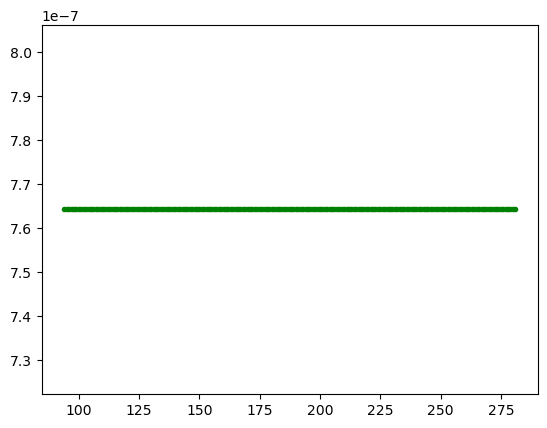
`Trainer.fit` stopped: `max_epochs=3` reached.csv_path = f"{trainer.logger.log_dir}/metrics.csv"
metrics = pd.read_csv(csv_path)
metrics.head()
plt.figure()
plt.plot(metrics['step'], metrics['train/loss_step'], 'b.-')
plt.plot(metrics['step'], metrics['val/loss'],'r.-')
plt.figure()
plt.plot(metrics['step'], metrics['lr-AdamW'], 'g.-')
plt.show()
trainer.test(model, datamodule.test_dataloader(), ckpt_path="best")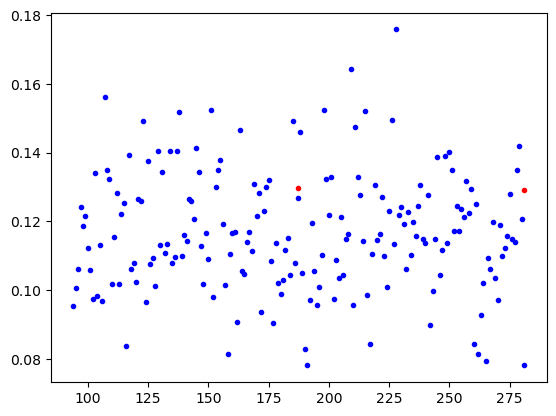
Restoring states from the checkpoint path at logs/fashion_mnist_convnet/version_14/checkpoints/epoch=2-step=282.ckpt
Loaded model weights from the checkpoint at logs/fashion_mnist_convnet/version_14/checkpoints/epoch=2-step=282.ckpt
/Users/slegroux/miniforge3/envs/nimrod/lib/python3.11/site-packages/lightning/pytorch/trainer/connectors/data_connector.py:424: The 'test_dataloader' does not have many workers which may be a bottleneck. Consider increasing the value of the `num_workers` argument` to `num_workers=11` in the `DataLoader` to improve performance.
┏━━━━━━━━━━━━━━━━━━━━━━━━━━━┳━━━━━━━━━━━━━━━━━━━━━━━━━━━┓ ┃ Test metric ┃ DataLoader 0 ┃ ┡━━━━━━━━━━━━━━━━━━━━━━━━━━━╇━━━━━━━━━━━━━━━━━━━━━━━━━━━┩ │ test/acc │ 0.9711999893188477 │ │ test/loss │ 0.11154787242412567 │ └───────────────────────────┴───────────────────────────┘